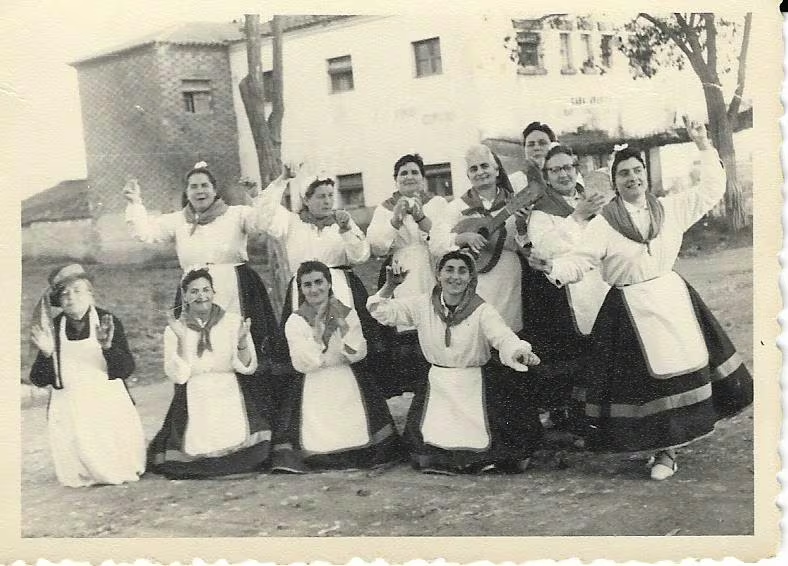
The festival
History and age
A festival with a long memory. Here we clearly separate what is documented, what is remembered and what is supposed.
How to read this timeline
Rigour is something to be proud of too
Espinosa’s church was destroyed in the Civil War, and no old papers of the Brotherhood appear in the documents consulted. What remains is partial. That is why each milestone carries a label showing what kind of evidence it is.
16th-17th c.
A study’s suppositionThe origin ethnography proposes
Miguel Mínguez writes that it «leads us to suppose» the festival dates back to these centuries, based on the legend of the bonfire and the shortage of firewood the village reported.
Miguel Mínguez Gutiérrez, Cuadernos de Etnología de Guadalajara, no. 17, 1991
Late 16th c.
Document on Espinosa«A land short of firewood»
In Philip II’s Relaciones, the people of Espinosa de Sobre Henares reply that their land lacks firewood and that they buy it from the surrounding hills. The document does not mention the festival, but gives meaning to its legend.
Quoted by Mínguez, 1991
1752
Document on EspinosaGeneral answers from the village
The village describes a common pasture with oak, holm oak, rockrose and broom. Firewood again, with no mention of the festival.
Quoted by Mínguez, 1991
1826
Regional context, not EspinosaA Saint Agatha brotherhood in Yunquera de Henares
The will of Jerónima Fernández Llanos leaves a chest to the brotherhood of that town, in the same valley. It is a valuable parallel, but it does not concern Espinosa.
Fr. Ramón Molina Piñedo, Cuadernos de Etnología de Guadalajara, nos. 45-46
19th c.
Oral memoryGrandmothers’ grandmothers
Mínguez records that the older women of the village said their grandmothers already celebrated the festival the same way. The Brotherhood’s statutes speak of «traditions from 200 years ago». This is memory, not a document, and we present it as such.
Mínguez, 1991; Statutes, 2003
1958
Document on EspinosaThe first image
A photograph of women chasing a man who refuses to give money or dance. It is the earliest date among the published plates.
Plate 7 in Mínguez, 1991
1960
PressABC and Nueva Alcarria
Luis Monje Ciruelo describes the festival in full detail: «a rebellious, rowdy, almost provocative air». It is the oldest report in our Press Archive.
1965-66
Oral memoryTelevision arrives, and there is a mayoress
The sisters recall that Spanish television came, that they borrowed skirts in Bustares and that Sátur was the first mayoress. The 1991 study confirms the TVE broadcast and publishes a photo of the proclamation dated 1965.
Sisters’ accounts; Mínguez, 1991, plate 1
1991
Document on EspinosaThe reference study
Miguel Mínguez Gutiérrez publishes «Santa Águeda y el Domingo de Gallo en Espinosa de Henares», with seven plates from 1958 to 1967.
Miguel Mínguez Gutiérrez, Cuadernos de Etnología de Guadalajara, no. 17, 1991
1998
Document on EspinosaAssociation and regional declaration
In March the members formally constitute the association at an assembly. In August the regional Directorate-General for Tourism declares the festival a Festival of Regional Tourist Interest, to be held on the first Saturday in February.
DOCM n.º 42, 11-09-1998, p. 7382
2022
PressBack after the pandemic
After the Covid cancellations the festival returns, with about a hundred águedas at Mass. Nueva Alcarria’s headline: «State of health EXCELLENT».
Nueva Alcarria, 2022
2026
Document on EspinosaHonorary Elder Sister
H.M. Queen Sofía accepts the appointment, communicated by Credential no. 202/2026.
Cultural value
The world upside down, with rules
Saint Agatha belongs to the winter festivals of reversal, before Carnival: for one day, those without public power exercise it in front of everyone, with everyone’s permission. Mínguez put it this way in 1991: the women «reversed their social roles, rebelling against established power and male dominance».
Espinosa brings features of its own: a legend that explains the fire through a very specific conflict, over firewood; an organisation with a draw, offices and an assembly; and the union of religion and festivity in a single day. Many villages in Castile and Guadalajara celebrate Saint Agatha, each in its own way. It is a shared heritage.
«When in the rest of Spain women were expected only to keep quiet with their heads bowed, here they decided to raise their voices and stand up.»
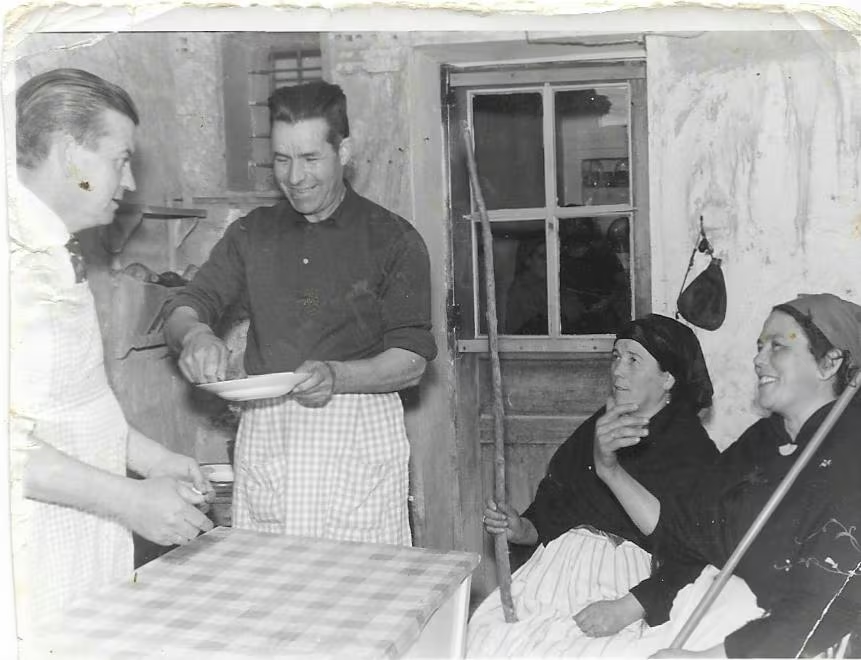
Two men in aprons serve the food. The women, seated with sticks, watch and laugh.
Memory
Domingo de Gallo, another festival of theirs
Mínguez’s study describes another winter tradition in Espinosa, this one for young people at Carnival: the girls, in groups, paraded a cockerel decorated with ribbons, which the boys tried to take from them, and they sang verses. It ended with a meal for everyone on the Tuesday.
As early as 1991 it was described as being «on the point of disappearing». It is not part of the Saint Agatha festival and is not held today; we recall it here as documentary heritage.
Sources
Where our account comes from
- Miguel Mínguez Gutiérrez, Cuadernos de Etnología de Guadalajara, no. 17, 1991, pp. 71-83.
- Resolution of August 1998, DOCM no. 42, p. 7382.
- The Brotherhood’s statutes, 2003, and assembly minutes of 1998.
- Press from 1960 to 2024: see the Press Archive.
- Recorded accounts by the sisters.
- Fr. Ramón Molina Piñedo, «Cabildos, cofradías y patronatos en Yunquera», Cuadernos de Etnología de Guadalajara, nos. 45-46, p. 133, on Yunquera de Henares.