Skip to content
Santa Águeda Espinosa de Henares Español

Memory

Press archive

Over sixty years of reports, from ABC in 1960 to today’s press.

«Almost provocative»

That is how ABC described the Espinosa festival on 5 February 1960.

ABC came back in 1965, 1977 and 2000, when the flamenco dancer Cristina Hoyos was Honorary Mayoress. La Vanguardia Española reported on it in 1962. The Guadalajara press has covered it steadily, and the sisters recall Spanish television arriving around 1965-66, just when they went to Bustares to borrow skirts.

5Pieces in national papers, 1960-2000
21Documents in this archive
TVEBroadcast cited in the 1991 study
CMM«Fiesteros» programme, 8 March 2026

Clippings

21 clippings shown

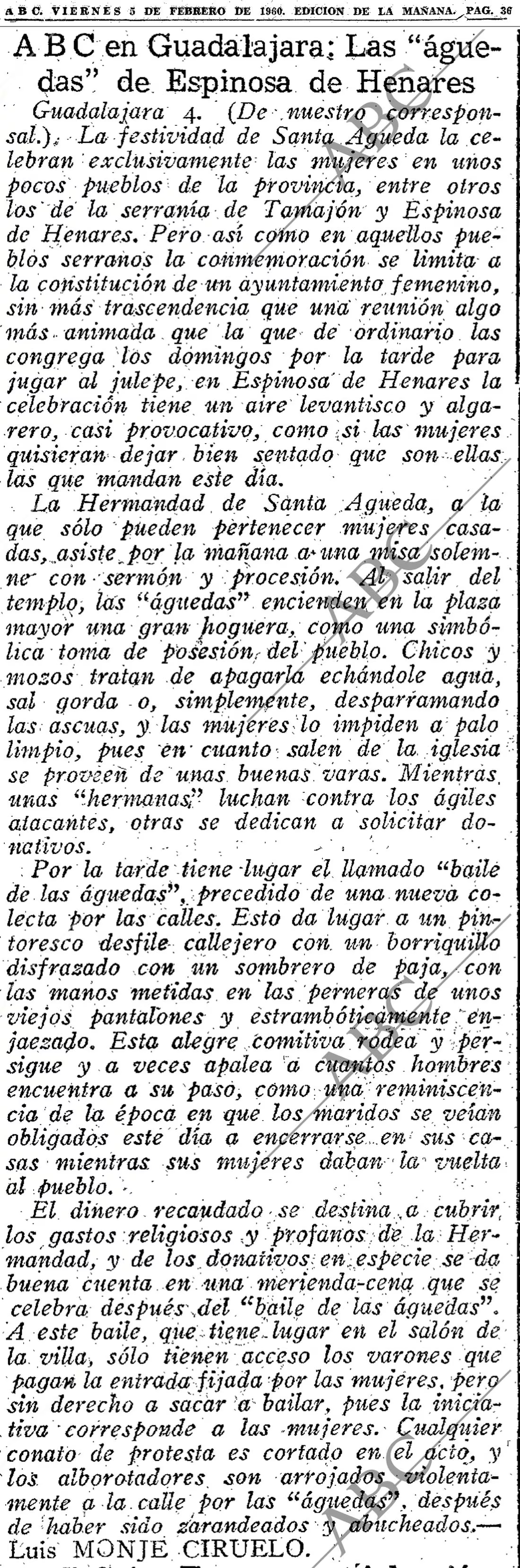
  • Clipping: ABC, 5/2/1960. ABC en Guadalajara: Las "águedas" de Espinosa de Henares (enlarge)
    National press

    ABC

    5/2/1960 · Luis Monje Ciruelo

    ABC en Guadalajara: Las "águedas" de Espinosa de Henares

    Report datelined Guadalajara on the 4th, setting Espinosa de Henares apart from the mountain villages, where the feast is limited to a women's town council. The Brotherhood of Saint Agatha, open only to married women, attends a solemn Mass with sermon and procession and lights a great bonfire in the main square, which boys and young men try to put out and the women defend with sticks. In the afternoon there is a collection with a costumed donkey and the "baile de las águedas", which men may enter only by paying and without the right to ask anyone to dance.

    «en Espinosa de Henares la celebración tiene un aire levantisco y algarero, casi provocativo, como si las mujeres quisieran dejar bien sentado que son ellas las que mandan este día.»
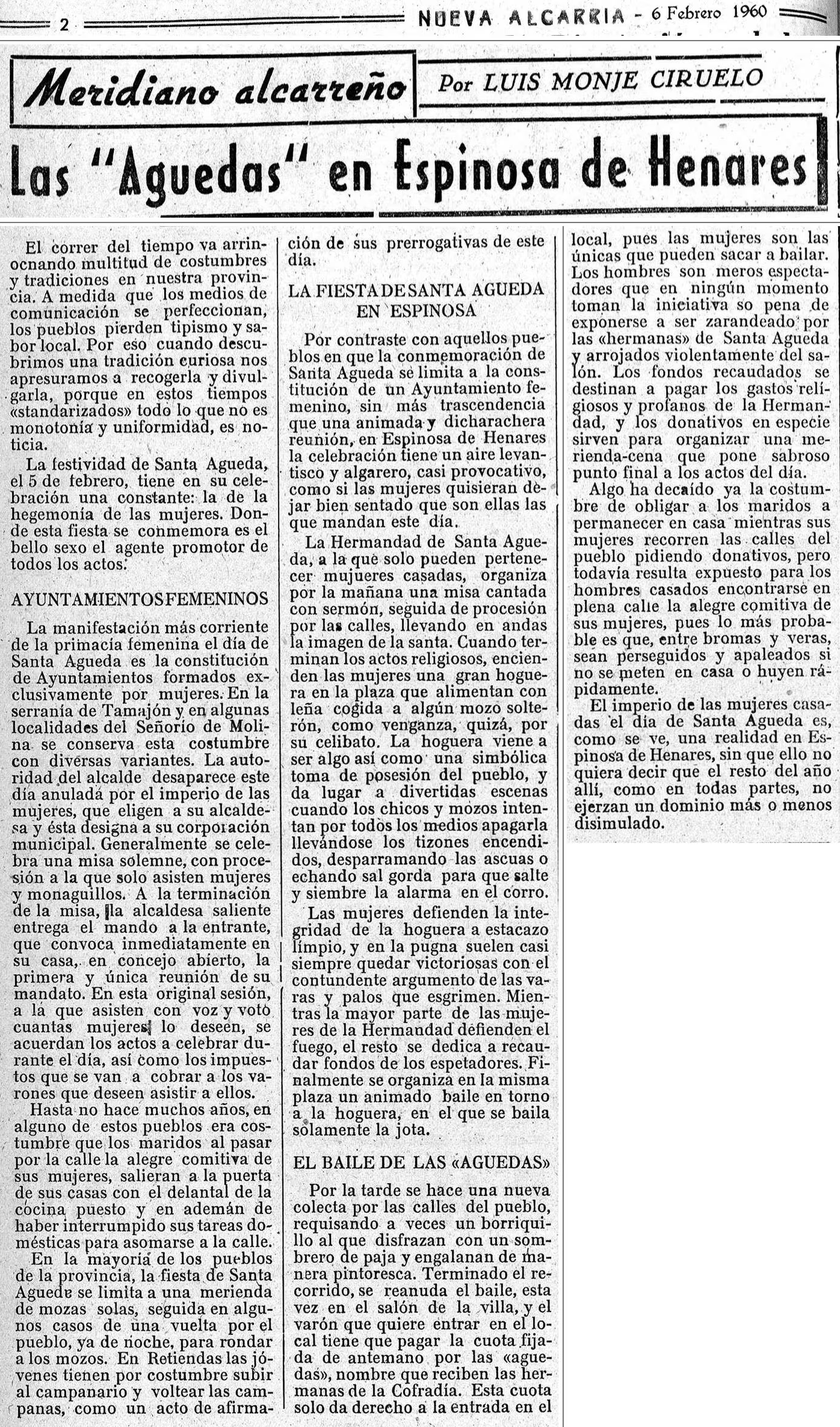
  • Clipping: Nueva Alcarria, 6/2/1960. Las "Aguedas" en Espinosa de Henares (sección «Meridiano alcarreño») (enlarge)
    Regional press

    Nueva Alcarria

    6/2/1960 · Luis Monje Ciruelo

    Las "Aguedas" en Espinosa de Henares (sección «Meridiano alcarreño»)

    In-depth article that starts from the loss of customs in the province and reviews the women's town councils of other villages before focusing on Espinosa. It describes the sung Mass with sermon, the procession with the image carried on a litter, the bonfire fed with wood taken from some old bachelor and its defence with sticks, and a dance around it in which only the jota is danced. It adds the collection with a donkey, the paid dance in the town hall and the supper, and notes that the custom of forcing husbands to stay at home has declined somewhat.

    «El imperio de las mujeres casadas el día de Santa Agueda es, como se ve, una realidad en Espinosa de Henares»

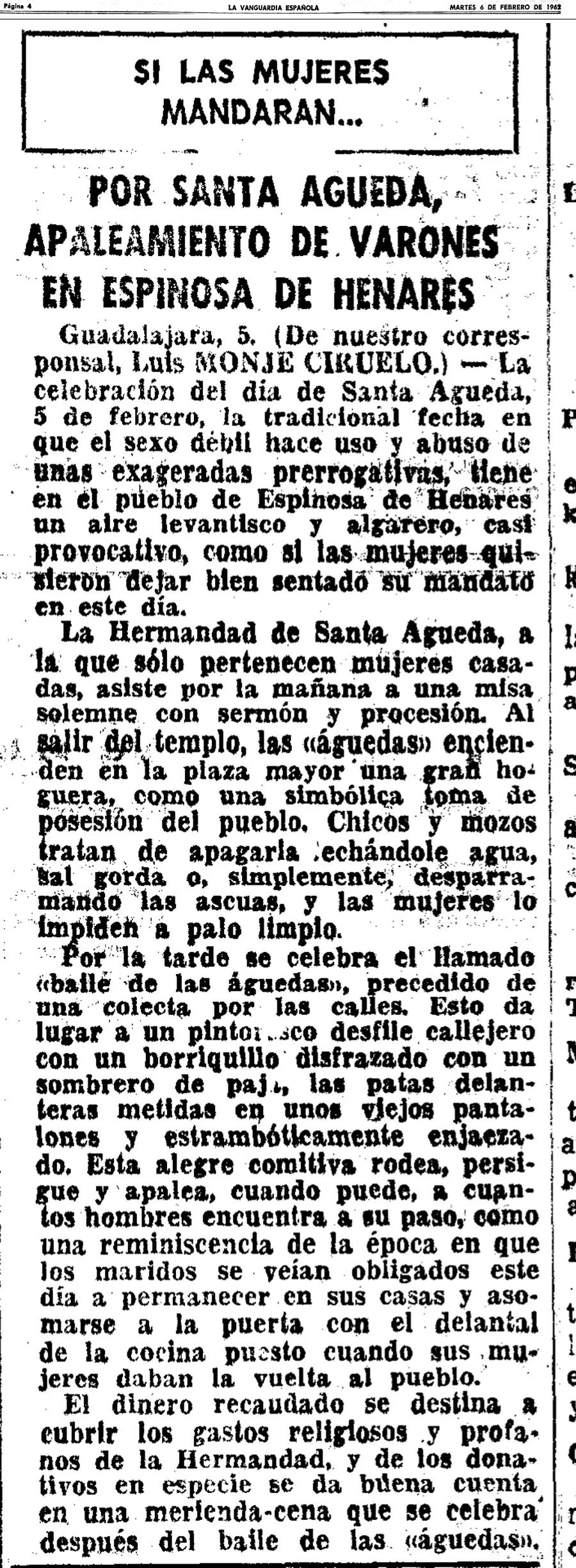
  • Clipping: La Vanguardia Española, 6/2/1962. Si las mujeres mandaran... Por Santa Águeda, apaleamiento de varones en Espinosa de Henares (enlarge)
    National press

    La Vanguardia Española

    6/2/1962 · Luis Monje Ciruelo

    Si las mujeres mandaran... Por Santa Águeda, apaleamiento de varones en Espinosa de Henares

    Report datelined Guadalajara on the 5th, presenting 5 February as the traditional date of the feast. The Brotherhood of Saint Agatha, open only to married women, attends Mass and procession and lights a great bonfire in the main square, which the women defend with sticks. In the afternoon, a parade with a costumed donkey surrounds, chases and, when it can, beats the men it comes across, and the collection pays for the Brotherhood's expenses and a supper.

    «tiene en el pueblo de Espinosa de Henares un aire levantisco y algarero, casi provocativo»

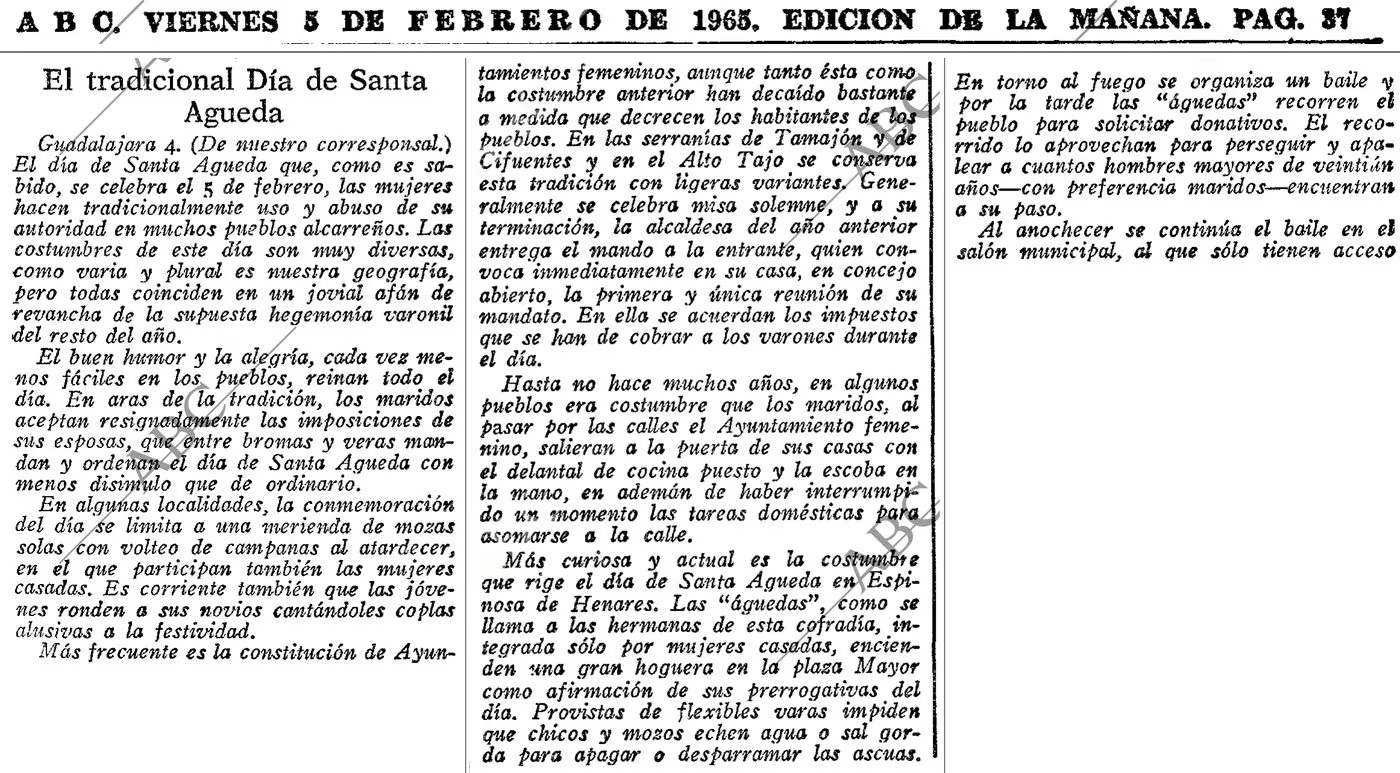
  • Clipping: ABC, 5/2/1965. El tradicional Día de Santa Agueda (enlarge)
    National press

    ABC

    5/2/1965

    El tradicional Día de Santa Agueda

    Provincial report on Saint Agatha's Day in the villages of La Alcarria, whose final part is devoted to Espinosa de Henares as the "most curious and current" custom. The águedas, a confraternity of married women only, light a great bonfire in the Plaza Mayor and use sticks to stop the young men putting it out. In the afternoon they go round the village asking for donations, chasing and beating men over twenty-one, husbands by preference.

    «Las “águedas”, como se llama a las hermanas de esta cofradía, integrada sólo por mujeres casadas, encienden una gran hoguera en la plaza Mayor como afirmación de sus prerrogativas del día.»

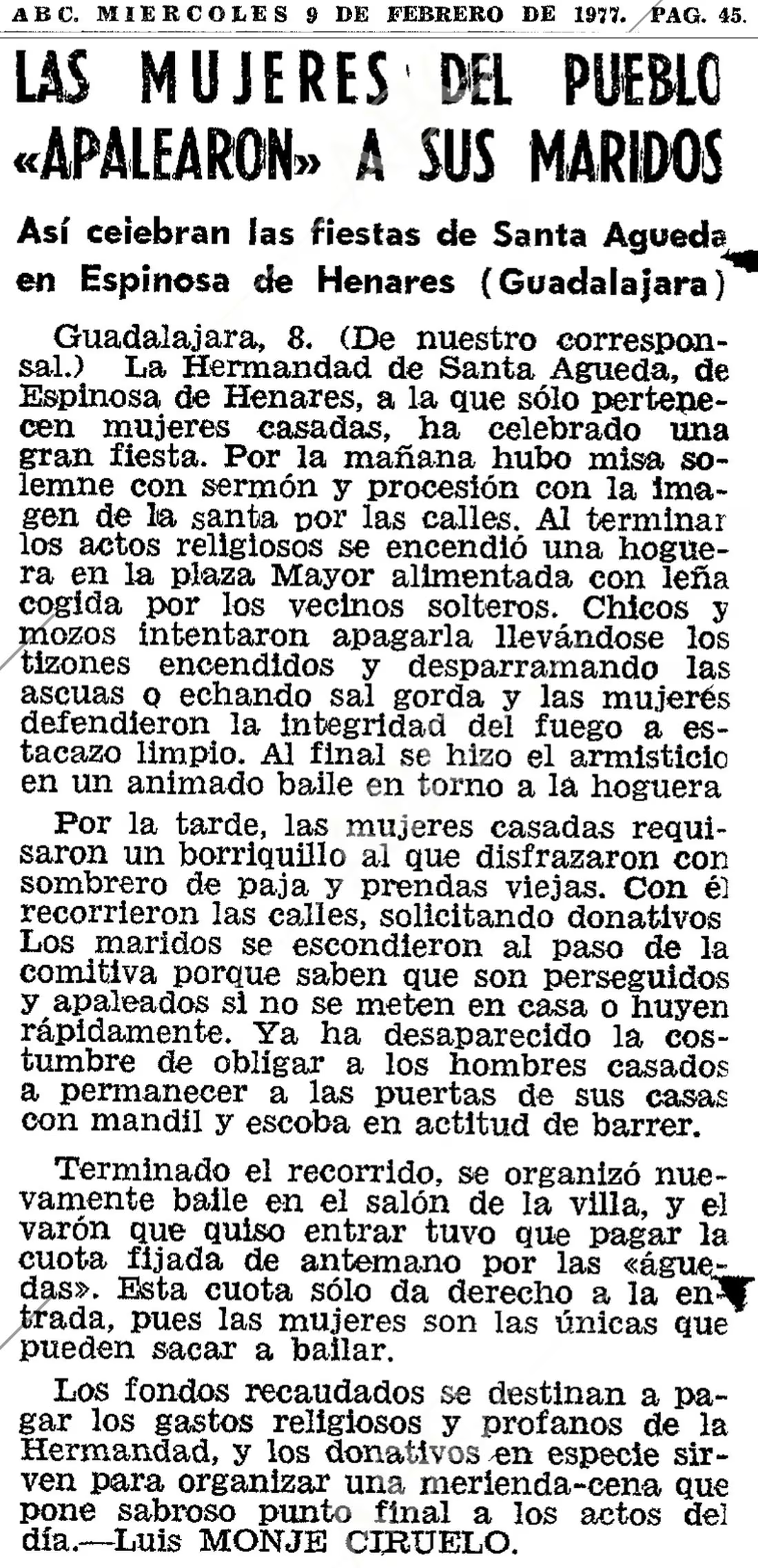
  • Clipping: ABC, 9/2/1977. Las mujeres del pueblo «apalearon» a sus maridos. Así celebran las fiestas de Santa Agueda en Espinosa de Henares (Guadalajara) (enlarge)
    National press

    ABC

    9/2/1977 · Luis Monje Ciruelo

    Las mujeres del pueblo «apalearon» a sus maridos. Así celebran las fiestas de Santa Agueda en Espinosa de Henares (Guadalajara)

    Past-tense report, datelined Guadalajara on the 8th, on the feast held by the Brotherhood of Saint Agatha of Espinosa de Henares. It covers the solemn Mass, the procession, the bonfire in the Plaza Mayor defended with sticks, the round with a costumed donkey and the paid dance in the town hall. It notes that the custom of forcing married men to stand at their doors with apron and broom has now disappeared.

    «Los maridos se escondieron al paso de la comitiva porque saben que son perseguidos y apaleados si no se meten en casa o huyen rápidamente.»

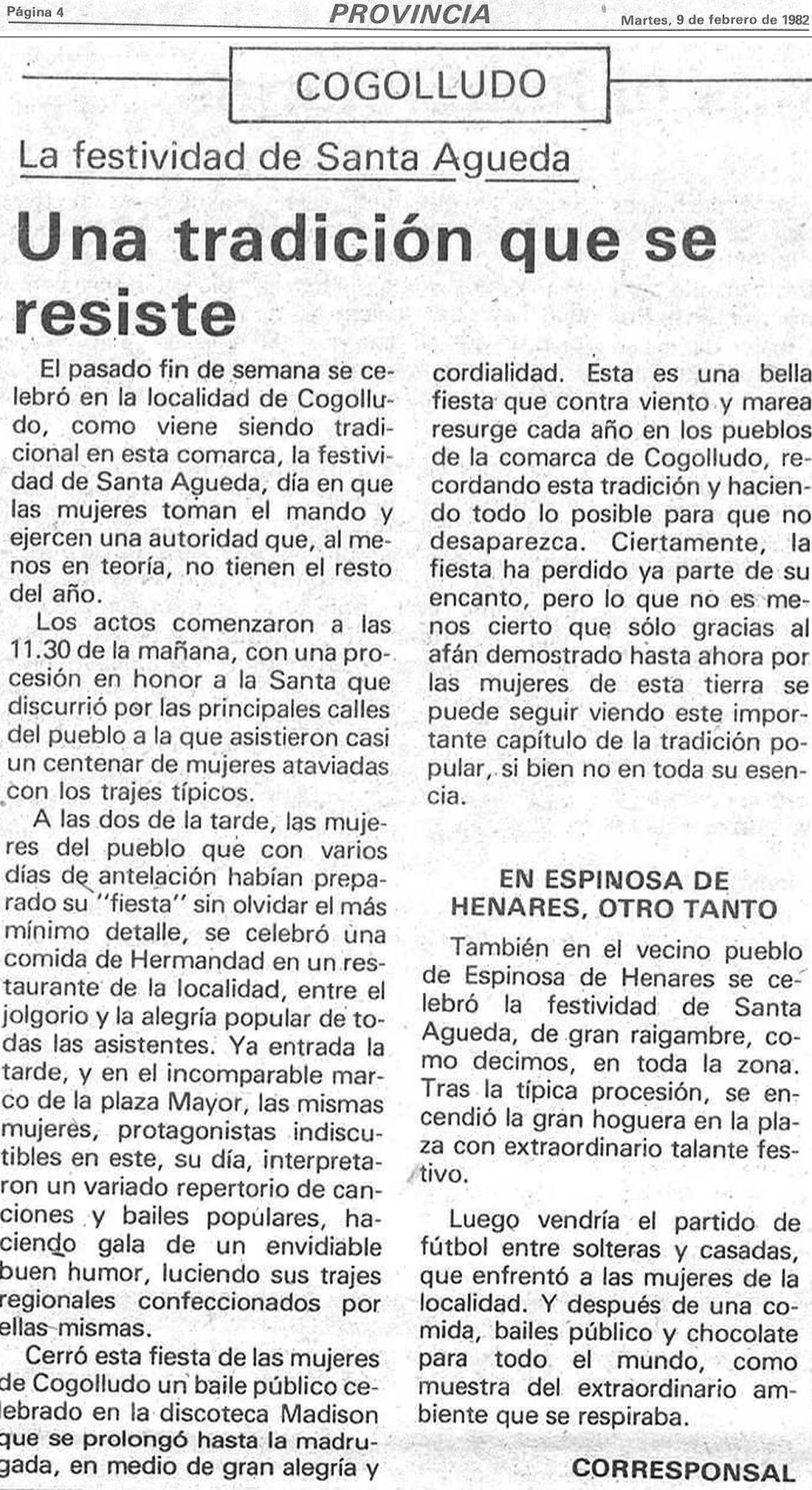
  • Clipping: La Prensa Alcarreña, 9/2/1982. La festividad de Santa Agueda: Una tradición que se resiste (ladillo: «En Espinosa de Henares, otro tanto») (enlarge)
    Regional press

    La Prensa Alcarreña

    9/2/1982

    La festividad de Santa Agueda: Una tradición que se resiste (ladillo: «En Espinosa de Henares, otro tanto»)

    Report focused on Cogolludo, with a final section on Espinosa de Henares, where the feast was also held. After the procession the great bonfire was lit in the square. This was followed by a football match between single and married women, a meal, dances and hot chocolate for everyone.

    «También en el vecino pueblo de Espinosa de Henares se celebró la festividad de Santa Agueda, de gran raigambre, como decimos, en toda la zona.»

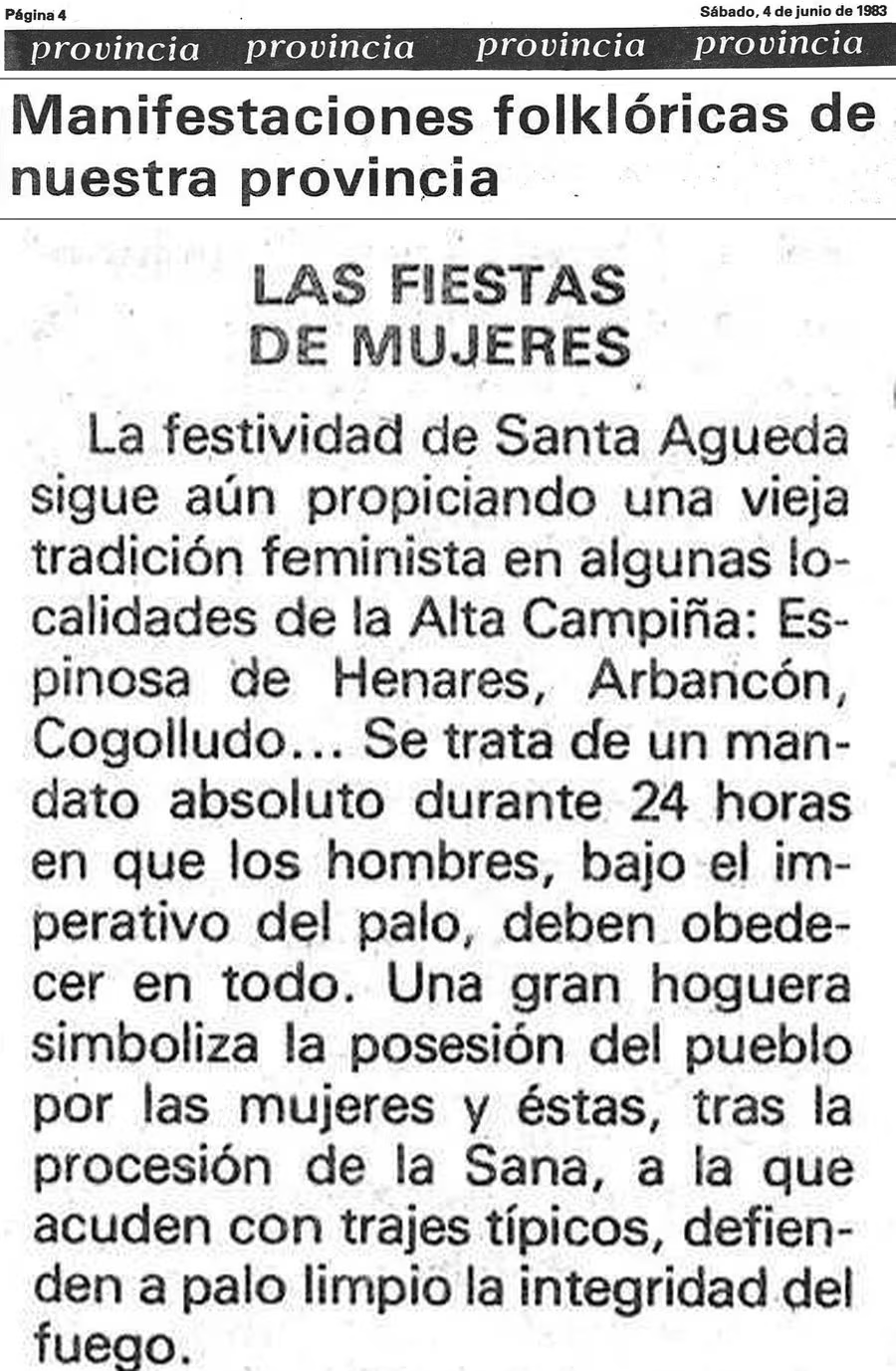
  • Clipping: Unidentified paper, 4/6/1983. Manifestaciones folklóricas de nuestra provincia (apartado «Las fiestas de mujeres») (enlarge)
    Unidentified paper

    Unidentified paper

    4/6/1983

    Manifestaciones folklóricas de nuestra provincia (apartado «Las fiestas de mujeres»)

    Overview of the main folk traditions of Guadalajara which, in its section on women's festivals, names Espinosa de Henares alongside Arbancón and Cogolludo. It describes Saint Agatha's Day as an absolute 24-hour rule by women, symbolised by a great bonfire that they defend with sticks after the procession.

    «Se trata de un mandato absoluto durante 24 horas en que los hombres, bajo el imperativo del palo, deben obedecer en todo.»

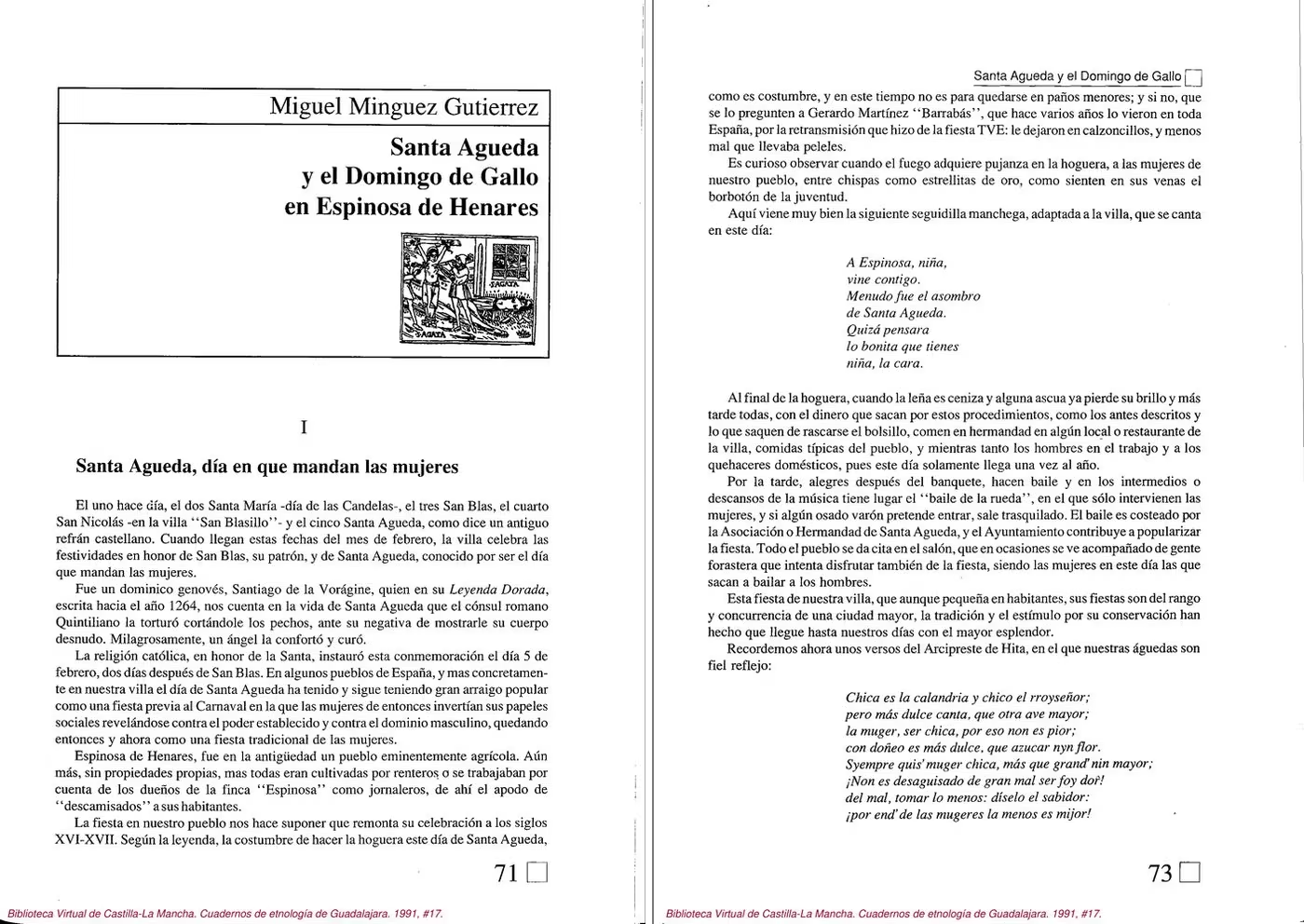
  • Clipping: Cuadernos de Etnología de Guadalajara, 1991. Santa Agueda y el Domingo de Gallo en Espinosa de Henares (enlarge)
    Regional press

    Cuadernos de Etnología de Guadalajara

    1991 · Miguel Mínguez Gutiérrez

    Santa Agueda y el Domingo de Gallo en Espinosa de Henares

    A 13-page study describing Espinosa's Saint Agatha festival and the Domingo de Gallo, with old folk verses and seven photographic plates from 1958 to 1967. It supposes that the festival originated in the 16th-17th centuries and recounts the proclamation of the mayoress, the Mass, the procession, the bonfire and the "baile de la rueda". It mentions in passing an undated broadcast of the festival by TVE.

    «que hace varios años lo vieron en toda España, por la retransmisión que hizo de la fiesta TVE: le dejaron en calzoncillos, y menos mal que llevaba peleles.»

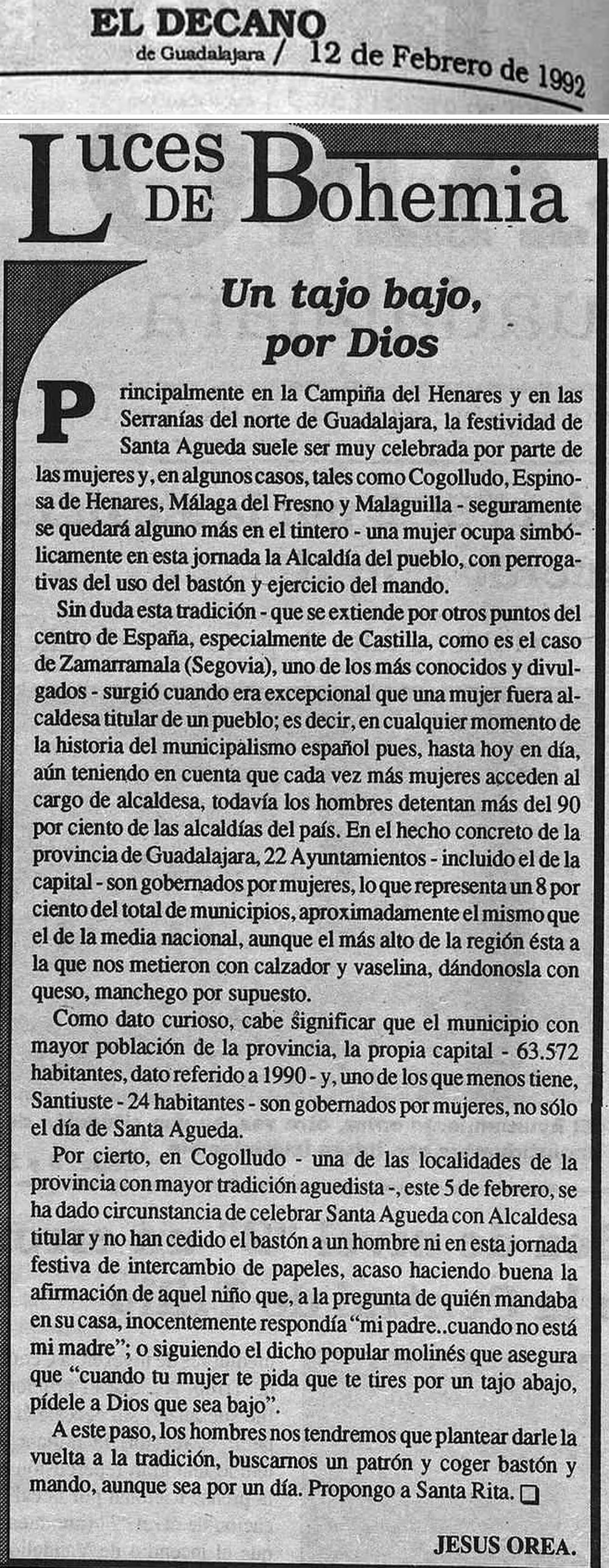
  • Clipping: El Decano de Guadalajara, 12/2/1992. Un tajo bajo, por Dios (sección «Luces de Bohemia») (enlarge)
    Regional press

    El Decano de Guadalajara

    12/2/1992 · Jesús Orea

    Un tajo bajo, por Dios (sección «Luces de Bohemia»)

    Opinion column on the tradition of mayoresses for a day, widely celebrated in the Campiña del Henares and the northern mountains of Guadalajara. It names Espinosa de Henares, together with Cogolludo, Málaga del Fresno and Malaguilla, among the places where a woman symbolically takes over the mayor's office. The rest of the text deals with actual women mayors in the province and the case of Cogolludo.

    «una mujer ocupa simbólicamente en esta jornada la Alcaldía del pueblo»

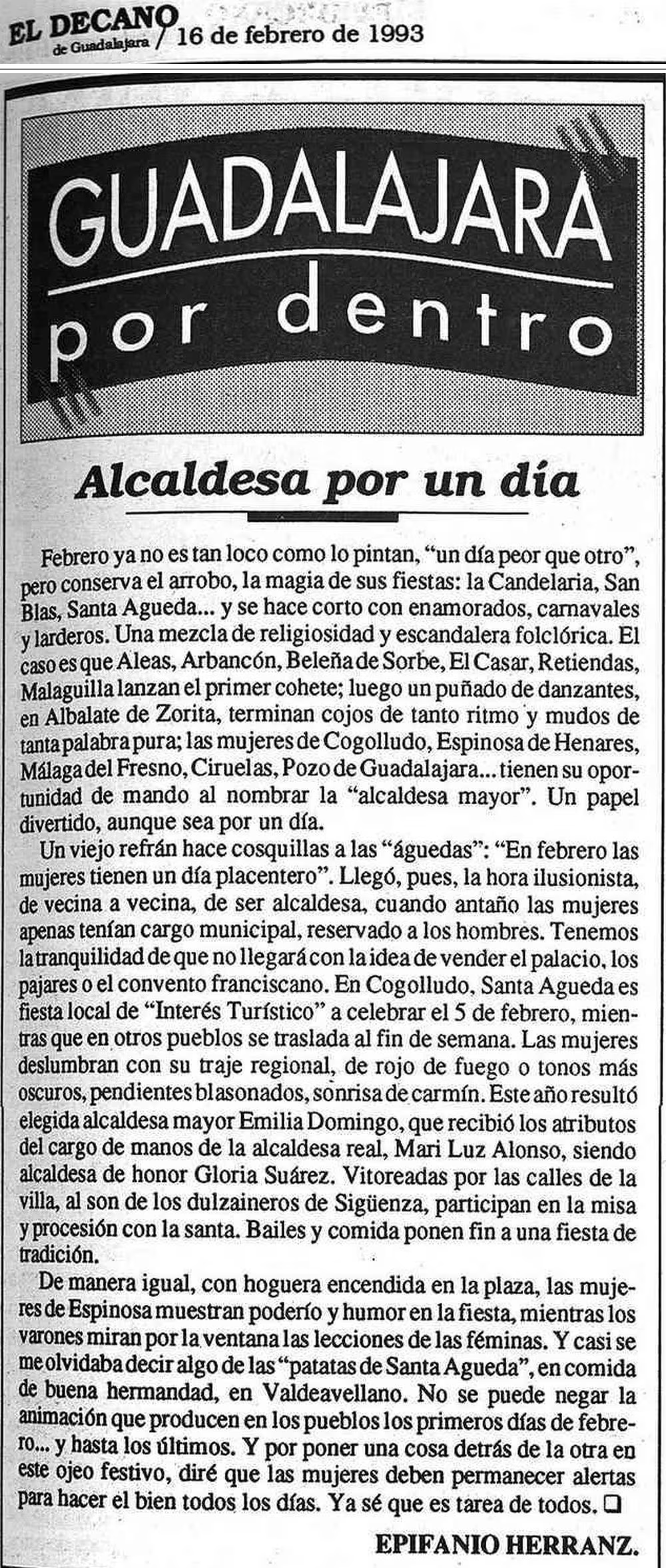
  • Clipping: El Decano de Guadalajara, 16/2/1993. Alcaldesa por un día (sección «Guadalajara por dentro») (enlarge)
    Regional press

    El Decano de Guadalajara

    16/2/1993 · Epifanio Herranz

    Alcaldesa por un día (sección «Guadalajara por dentro»)

    Column on February festivals in the province, naming the women of Espinosa de Henares among those who appoint an "alcaldesa mayor". Most of it is devoted to Cogolludo, with one sentence on Espinosa: a bonfire lit in the square, the women's power and humour, and men watching from the window.

    «las mujeres de Espinosa muestran poderío y humor en la fiesta, mientras los varones miran por la ventana las lecciones de las féminas.»

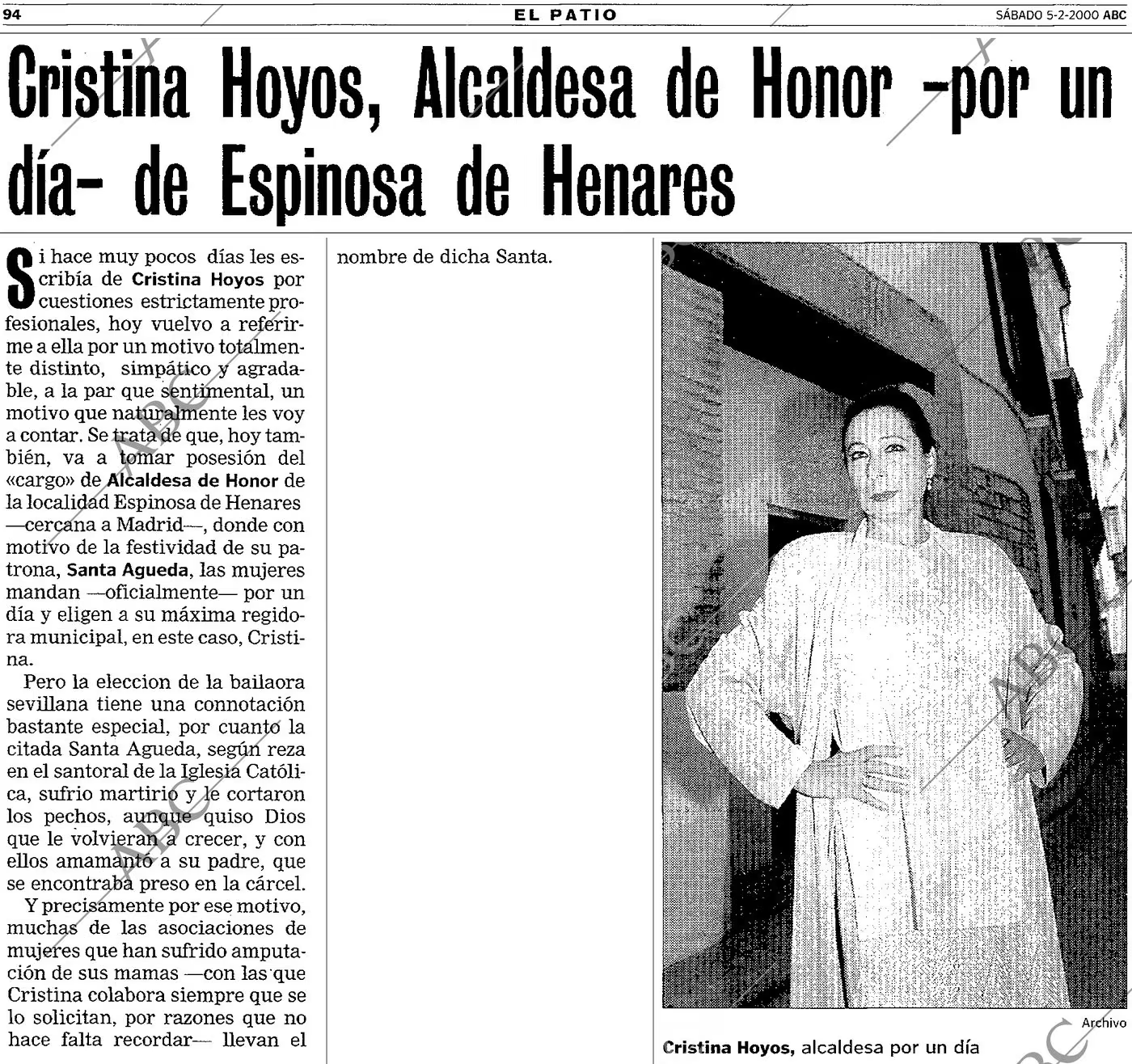
  • Clipping: ABC, 5/2/2000. Cristina Hoyos, Alcaldesa de Honor -por un día- de Espinosa de Henares (enlarge)
    National press

    ABC

    5/2/2000 · José Luis Montoya

    Cristina Hoyos, Alcaldesa de Honor -por un día- de Espinosa de Henares

    The Sevillian flamenco dancer Cristina Hoyos takes up that day the "post" of Honorary Mayoress of Espinosa de Henares, where on Saint Agatha's Day women officially rule for a day. The author explains that the choice has a special connotation: the saint's breasts were cut off, and many associations of women who have undergone mastectomies, with which Hoyos collaborates, bear her name. It includes an archive photo of the artist captioned "mayoress for a day".

    «va a tomar posesión del «cargo» de Alcaldesa de Honor de la localidad Espinosa de Henares —cercana a Madrid—, donde con motivo de la festividad de su patrona, Santa Agueda, las mujeres mandan —oficialmente— por un día»

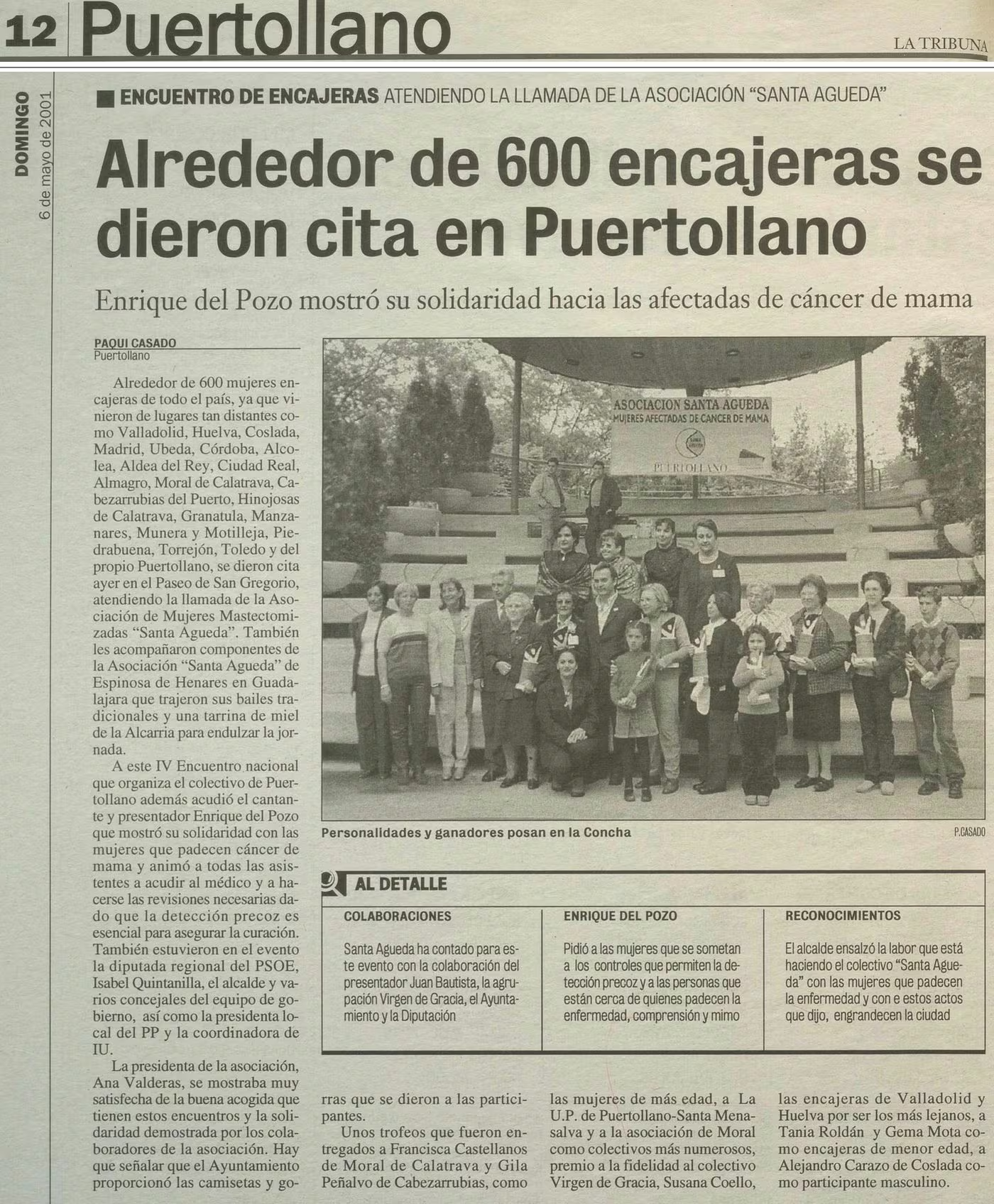
  • Clipping: La Tribuna, 6/5/2001. Alrededor de 600 encajeras se dieron cita en Puertollano (enlarge)
    Regional press

    La Tribuna

    6/5/2001 · Paqui Casado

    Alrededor de 600 encajeras se dieron cita en Puertollano

    News item on the 4th national lacemakers' meeting in Puertollano, organised by that city's "Santa Águeda" Association of Women with Mastectomies. Members of the "Santa Águeda" Association of Espinosa de Henares attended, bringing their traditional dances and a tub of Alcarria honey.

    «También les acompañaron componentes de la Asociación “Santa Agueda” de Espinosa de Henares en Guadalajara que trajeron sus bailes tradicionales y una tarrina de miel de la Alcarria para endulzar la jornada.»

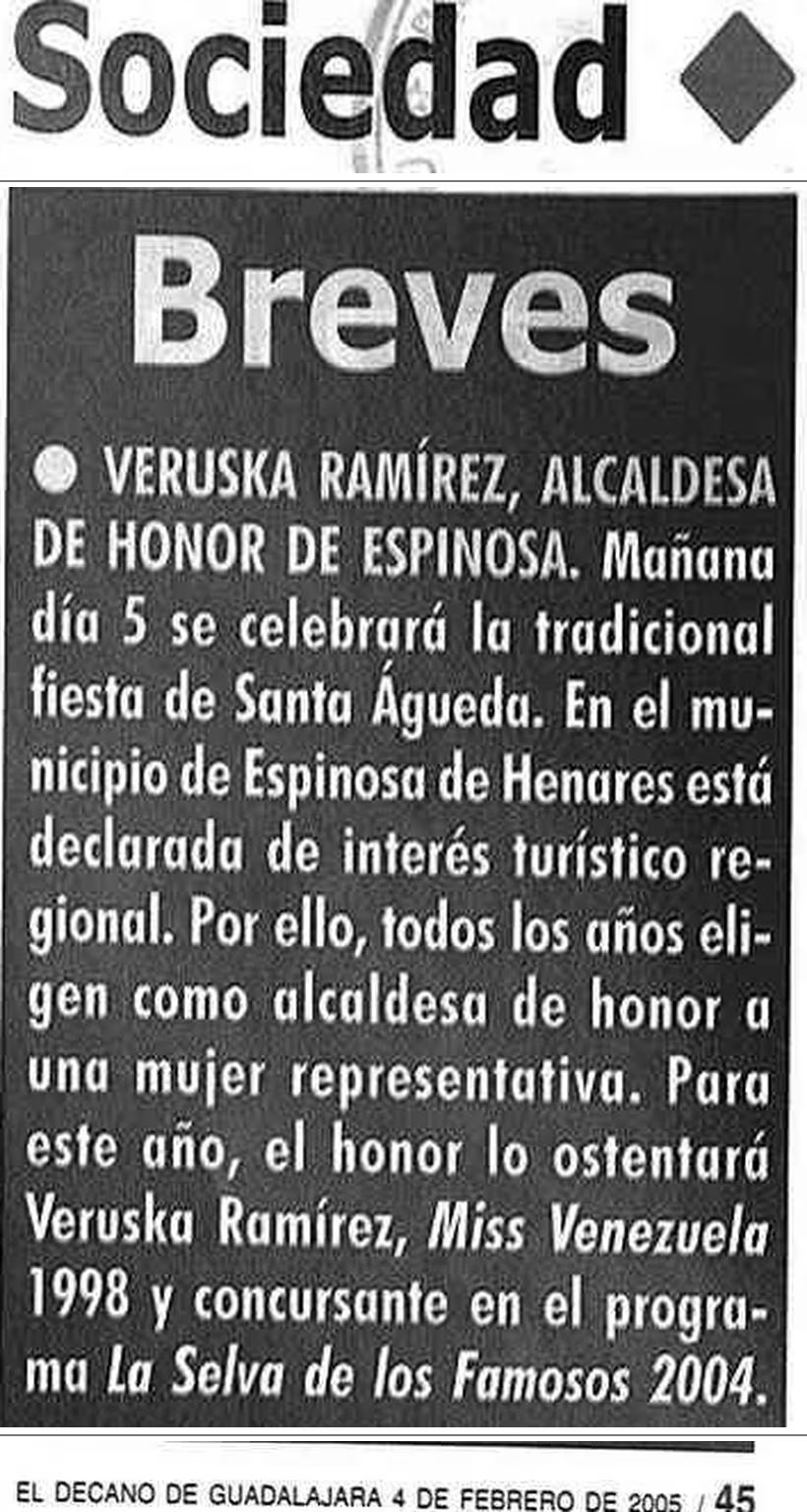
  • Clipping: El Decano de Guadalajara, 4/2/2005. Veruska Ramírez, alcaldesa de honor de Espinosa (enlarge)
    Regional press

    El Decano de Guadalajara

    4/2/2005

    Veruska Ramírez, alcaldesa de honor de Espinosa

    Short item announcing for the following day, the 5th, the Saint Agatha festival in Espinosa de Henares, declared of regional tourist interest. It says that each year a representative woman is chosen as honorary mayoress and that this year it will be Veruska Ramírez.

    «todos los años eligen como alcaldesa de honor a una mujer representativa»

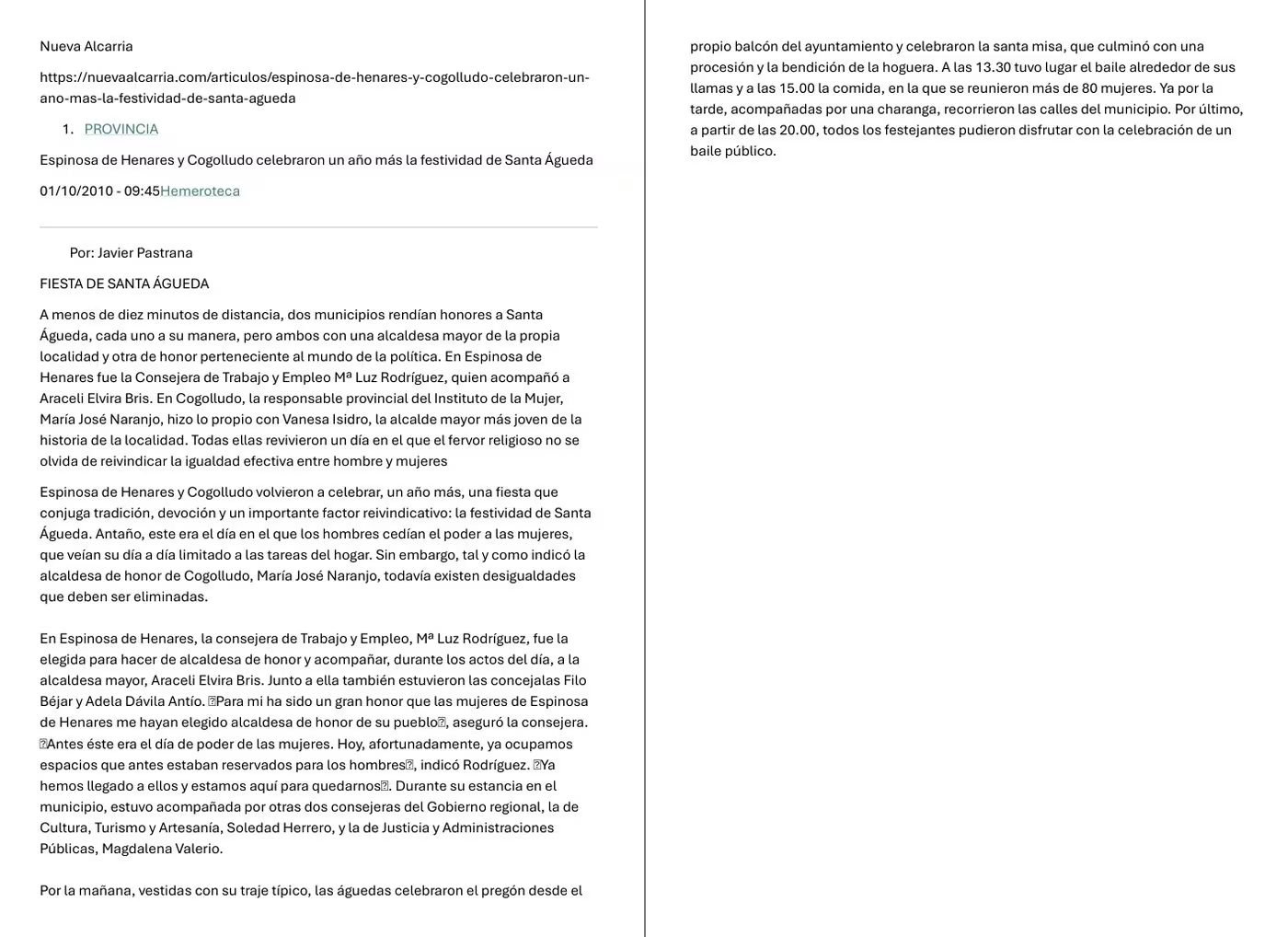
  • Clipping: Nueva Alcarria, 2010. Espinosa de Henares y Cogolludo celebraron un año más la festividad de Santa Águeda (enlarge)
    Regional press

    Nueva Alcarria

    2010 · Javier Pastrana

    Espinosa de Henares y Cogolludo celebraron un año más la festividad de Santa Águeda

    Report on the festival in both villages. In Espinosa, the regional minister of Labour and Employment, Mª Luz Rodríguez, was honorary mayoress alongside the chief mayoress, Araceli Elvira Bris, and was also accompanied by two other regional ministers. There was a proclamation from the town hall balcony, Mass, a procession, the blessing of the bonfire and dancing around it, a meal for more than 80 women, a brass band through the streets and a public dance.

    «Para mi ha sido un gran honor que las mujeres de Espinosa de Henares me hayan elegido alcaldesa de honor de su pueblo»

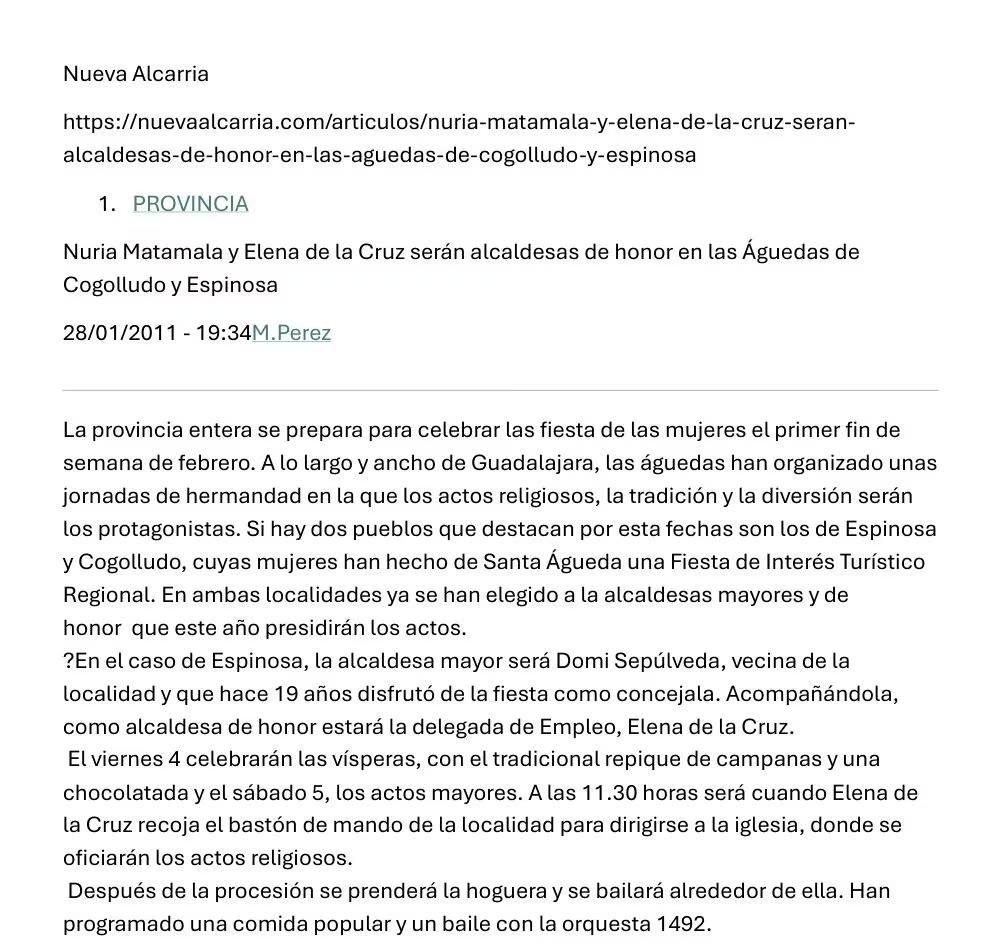
  • Clipping: Nueva Alcarria, 28/1/2011. Nuria Matamala y Elena de la Cruz serán alcaldesas de honor en las Águedas de Cogolludo y Espinosa (enlarge)
    Regional press

    Nueva Alcarria

    28/1/2011 · M. Pérez

    Nuria Matamala y Elena de la Cruz serán alcaldesas de honor en las Águedas de Cogolludo y Espinosa

    Preview presenting Espinosa and Cogolludo as the villages that stand out at this time of year. In Espinosa the chief mayoress will be Domi Sepúlveda and the honorary mayoress the Employment delegate, Elena de la Cruz. Friday the 4th will bring vespers with bell-ringing and hot chocolate, and Saturday the 5th the main events: staff of office, religious services, procession, bonfire, a communal meal and a dance with the band 1492.

    «Si hay dos pueblos que destacan por esta fechas son los de Espinosa y Cogolludo, cuyas mujeres han hecho de Santa Águeda una Fiesta de Interés Turístico Regional.»

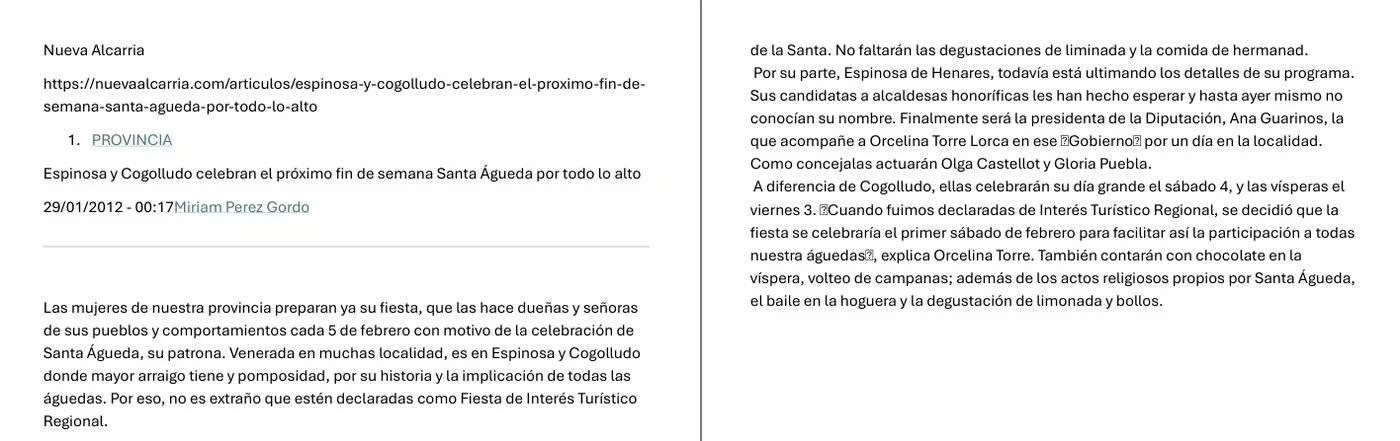
  • Clipping: Nueva Alcarria, 29/1/2012. Espinosa y Cogolludo celebran el próximo fin de semana Santa Águeda por todo lo alto (enlarge)
    Regional press

    Nueva Alcarria

    29/1/2012 · Miriam Pérez Gordo

    Espinosa y Cogolludo celebran el próximo fin de semana Santa Águeda por todo lo alto

    Preview of the festival in both villages. In Espinosa, the president of the Provincial Council, Ana Guarinos, will be honorary mayoress alongside Orcelina Torre Lorca, with Olga Castellot and Gloria Puebla as councillors. The main day will be Saturday the 4th, with vespers on Friday the 3rd, because, Orcelina Torre explains, when the festival was declared of Regional Tourist Interest it was decided to hold it on the first Saturday of February to make participation easier.

    «Cuando fuimos declaradas de Interés Turístico Regional, se decidió que la fiesta se celebraría el primer sábado de febrero para facilitar así la participación a todas nuestra águedas»

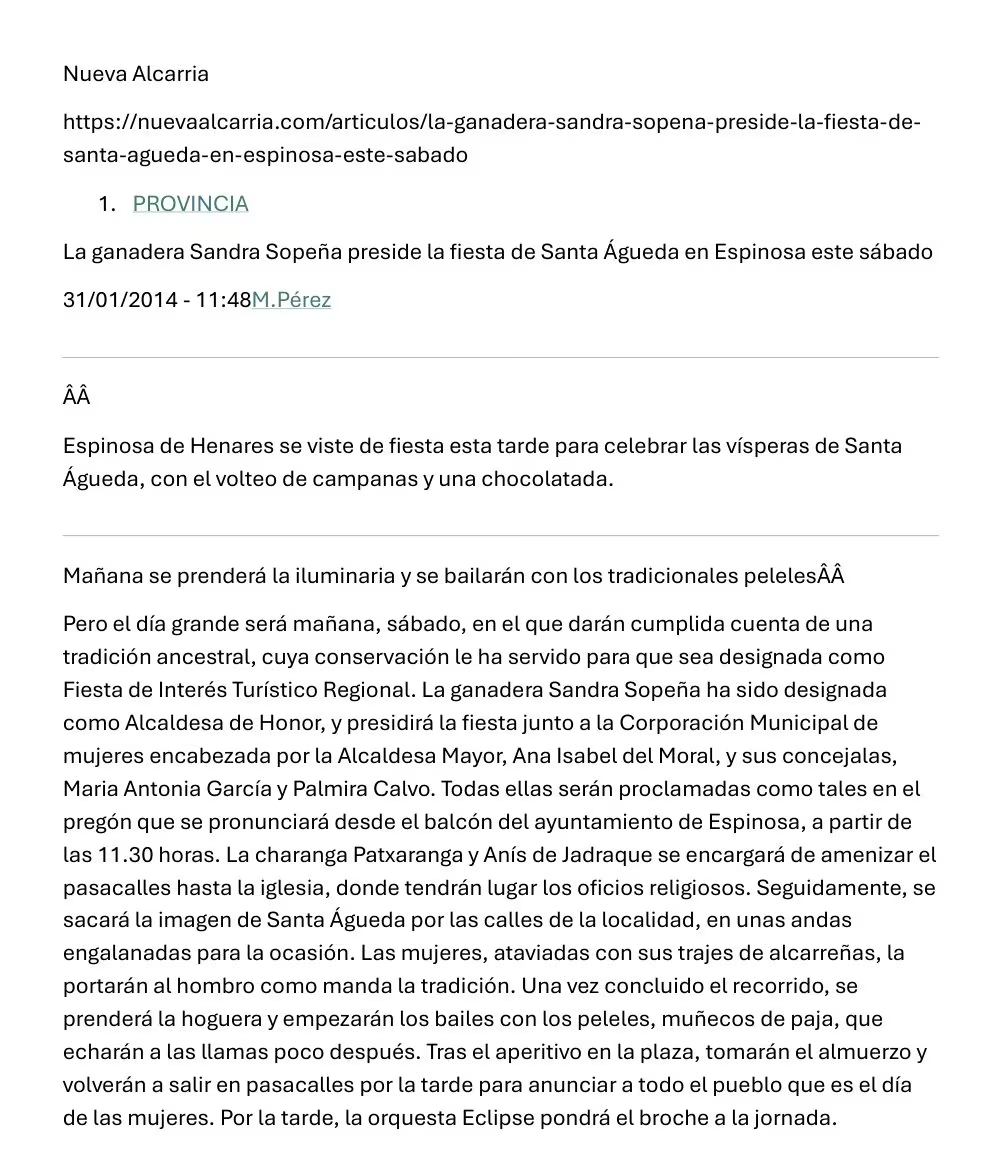
  • Clipping: Nueva Alcarria, 31/1/2014. La ganadera Sandra Sopeña preside la fiesta de Santa Águeda en Espinosa este sábado (enlarge)
    Regional press

    Nueva Alcarria

    31/1/2014 · M. Pérez

    La ganadera Sandra Sopeña preside la fiesta de Santa Águeda en Espinosa este sábado

    Preview announcing vespers with bell-ringing and hot chocolate, and Saturday as the main day. The cattle breeder Sandra Sopeña will be Honorary Mayoress, with Chief Mayoress Ana Isabel del Moral and councillors Maria Antonia García and Palmira Calvo. It details the proclamation from the balcony at 11.30, the street parade, the religious services, the procession with the litter carried on the shoulder, the bonfire, the dance with straw effigies then thrown into the flames, and the evening band.

    «una tradición ancestral, cuya conservación le ha servido para que sea designada como Fiesta de Interés Turístico Regional»

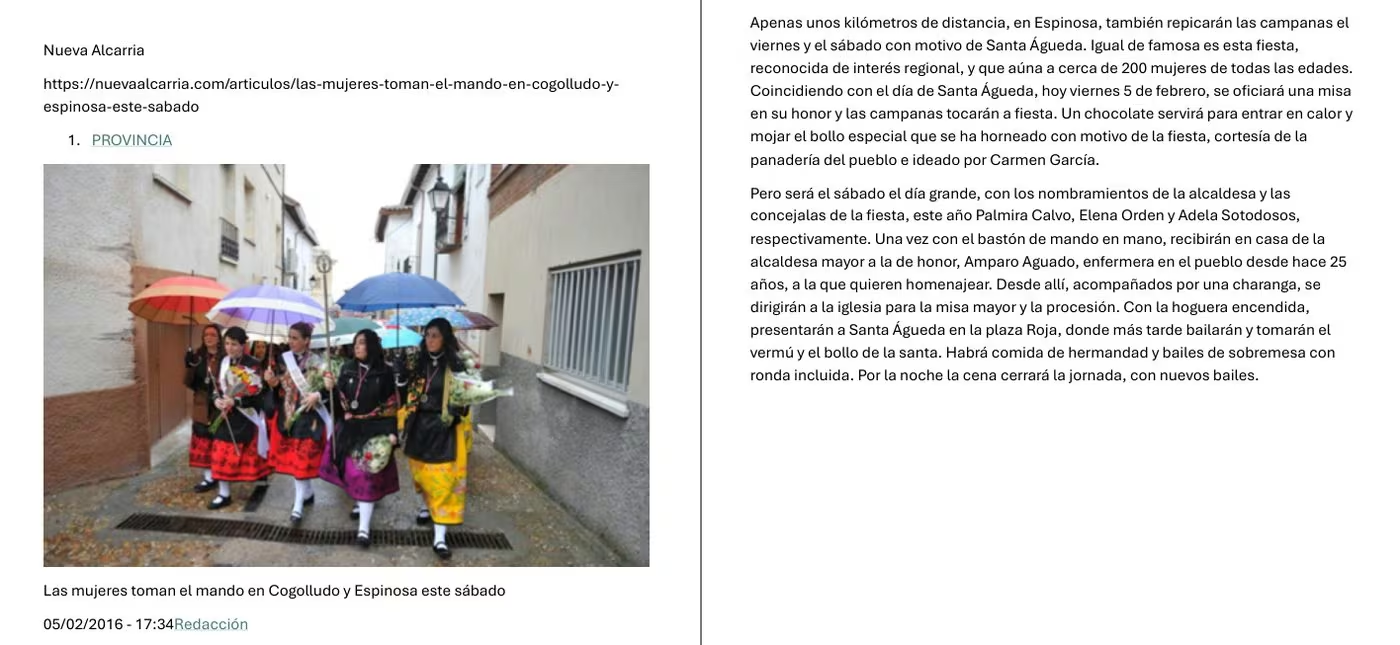
  • Clipping: Nueva Alcarria, 5/2/2016. Las mujeres toman el mando en Cogolludo y Espinosa este sábado (enlarge)
    Regional press

    Nueva Alcarria

    5/2/2016

    Las mujeres toman el mando en Cogolludo y Espinosa este sábado

    Preview of the festival in both villages. In Espinosa, which brings together about 200 women of all ages, Friday 5 February has Mass, bells and hot chocolate with a special bun, and Saturday is the main day. That day Palmira Calvo, Elena Orden and Adela Sotodosos are appointed, and the honorary mayoress is Amparo Aguado, the village nurse for 25 years; then come High Mass, the procession, the bonfire, vermouth, a communal meal and dances.

    «Igual de famosa es esta fiesta, reconocida de interés regional, y que aúna a cerca de 200 mujeres de todas las edades.»

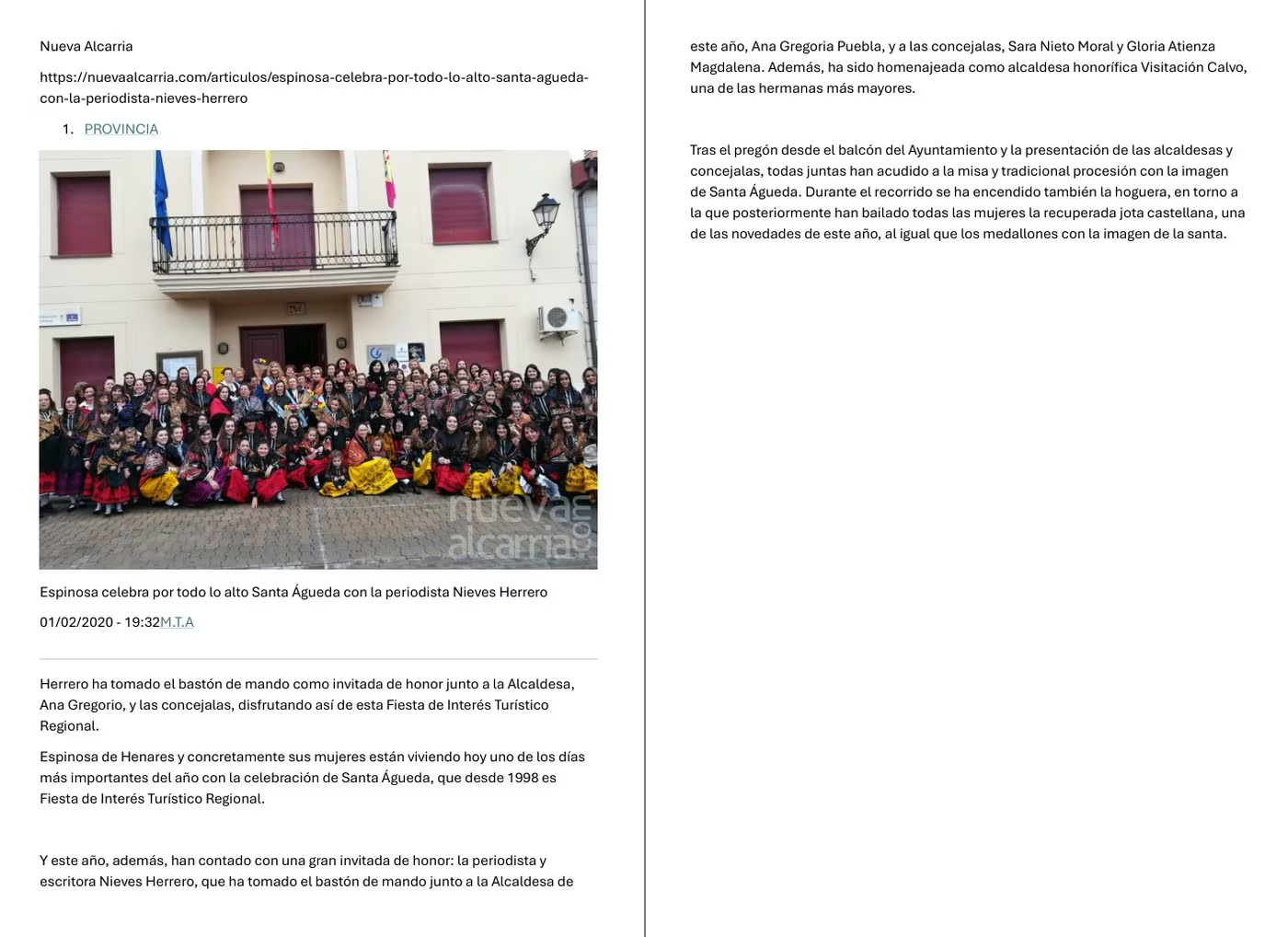
  • Clipping: Nueva Alcarria, 1/2/2020. Espinosa celebra por todo lo alto Santa Águeda con la periodista Nieves Herrero (enlarge)
    Regional press

    Nueva Alcarria

    1/2/2020 · M.T.A.

    Espinosa celebra por todo lo alto Santa Águeda con la periodista Nieves Herrero

    Report on the festival, a Festival of Regional Tourist Interest since 1998, with the journalist and writer Nieves Herrero as guest of honour, who took the staff of office with the mayoress and councillors. Visitación Calvo, one of the oldest sisters, was honoured as honorific mayoress. After the proclamation, Mass and procession with bonfire, the women danced the recovered Castilian jota, a new feature that year along with the medallions bearing the saint's image.

    «Santa Águeda, que desde 1998 es Fiesta de Interés Turístico Regional»

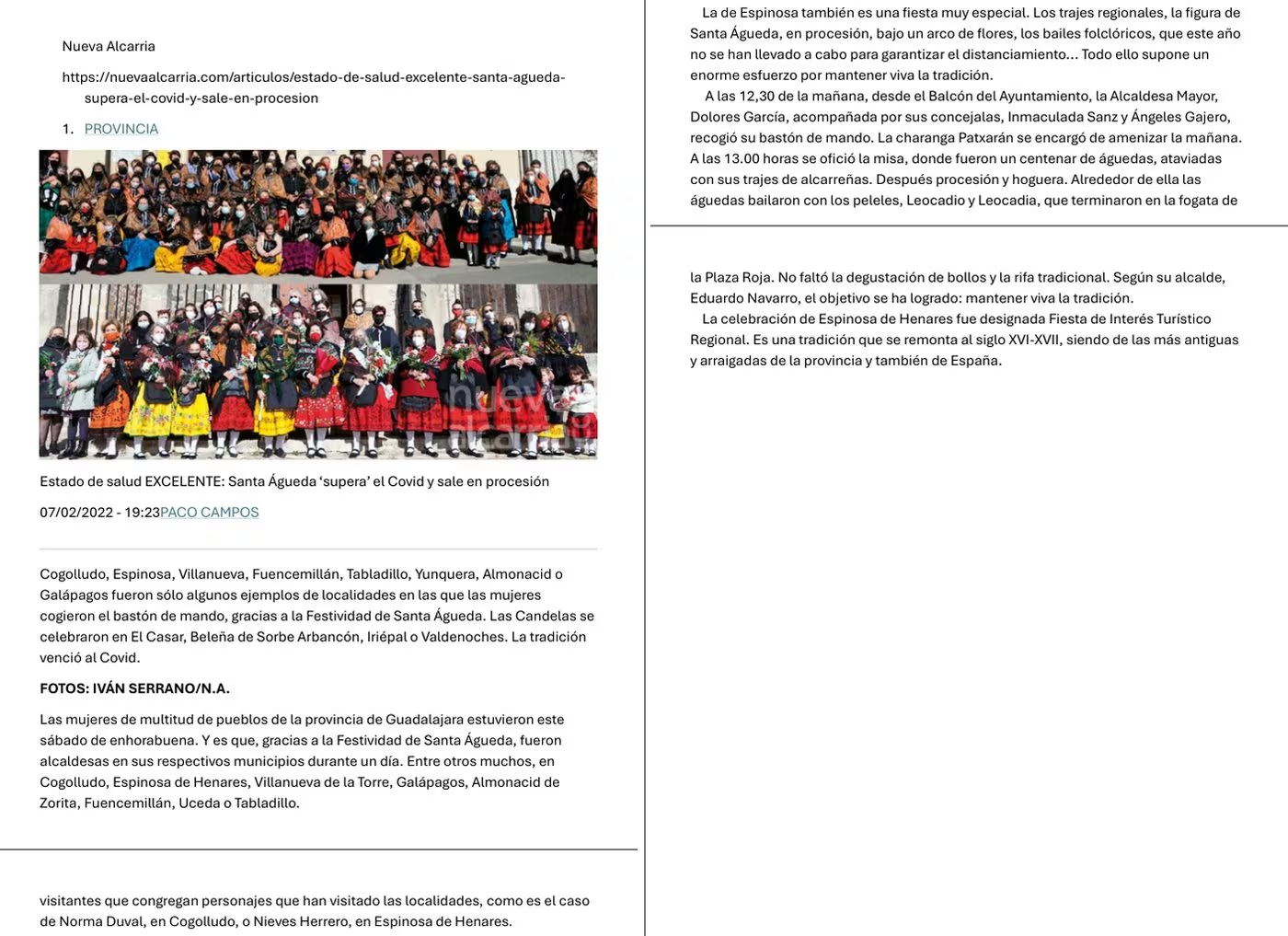
  • Clipping: Nueva Alcarria, 7/2/2022. Estado de salud EXCELENTE: Santa Águeda ‘supera’ el Covid y sale en procesión (enlarge)
    Regional press

    Nueva Alcarria

    7/2/2022 · Paco Campos

    Estado de salud EXCELENTE: Santa Águeda ‘supera’ el Covid y sale en procesión

    Provincial report on the return of Saint Agatha's Day after the Covid cancellations. In Espinosa, Chief Mayoress Dolores García received the staff on the balcony with her councillors; there was Mass with about a hundred águedas, a procession and bonfire, and a dance with the effigies Leocadio and Leocadia, which ended up in the fire in the Plaza Roja; the folk dances were not held so as to keep distance. The article states that Espinosa's tradition goes back to the 16th-17th century.

    «Es una tradición que se remonta al siglo XVI-XVII, siendo de las más antiguas y arraigadas de la provincia y también de España.»

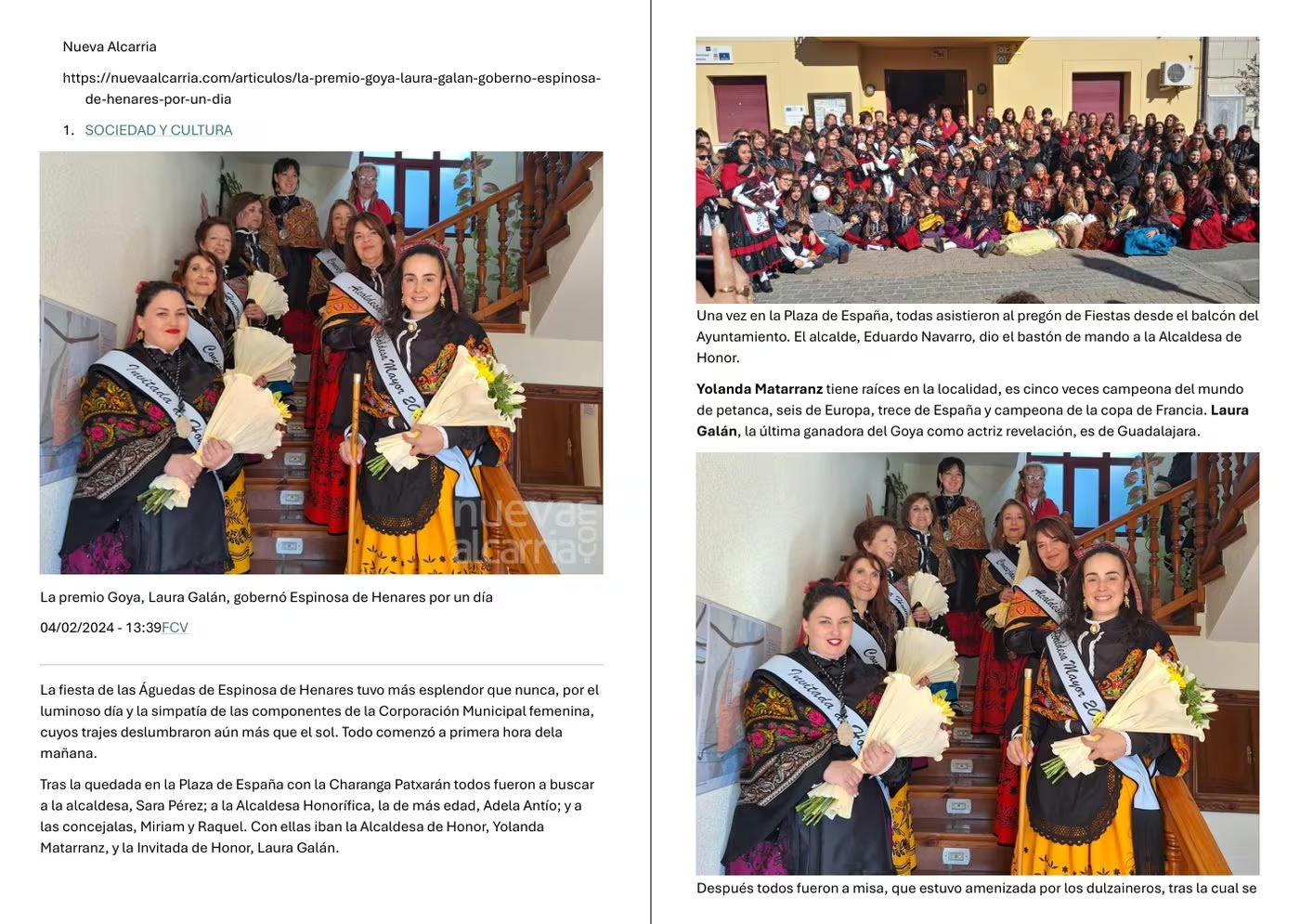
  • Clipping: Nueva Alcarria, 4/2/2024. La premio Goya, Laura Galán, gobernó Espinosa de Henares por un día (enlarge)
    Regional press

    Nueva Alcarria

    4/2/2024 · FCV

    La premio Goya, Laura Galán, gobernó Espinosa de Henares por un día

    Report on the festival, with the actress Laura Galán as Guest of Honour and the sportswoman Yolanda Matarranz as Honorary Mayoress, alongside mayoress Sara Pérez, Honorific Mayoress Adela Antío and councillors Miriam and Raquel. There was a proclamation from the balcony, the handing over of the staff by mayor Eduardo Navarro, Mass with dulzaina players, a procession, a bonfire and a jota. Then came the dance in the Plaza Roja, the communal meal, the burning of the effigies, supper and the final dance.

    «La fiesta de las Águedas de Espinosa de Henares tuvo más esplendor que nunca»

On television

Miguel Mínguez’s study (1991) says that a villager «was seen all over Spain, thanks to TVE’s broadcast of the festival». More recently, Castilla-La Mancha Media devoted part of its programme Fiesteros to Espinosa de Henares.

Headlines and quotations appear in their original Spanish for documentary purposes. The wording of old reports reflects the outlook of their time. Rights to the texts belong to their publishers.